
Outsourcing IoT Development: What to Expect and How to Prepare
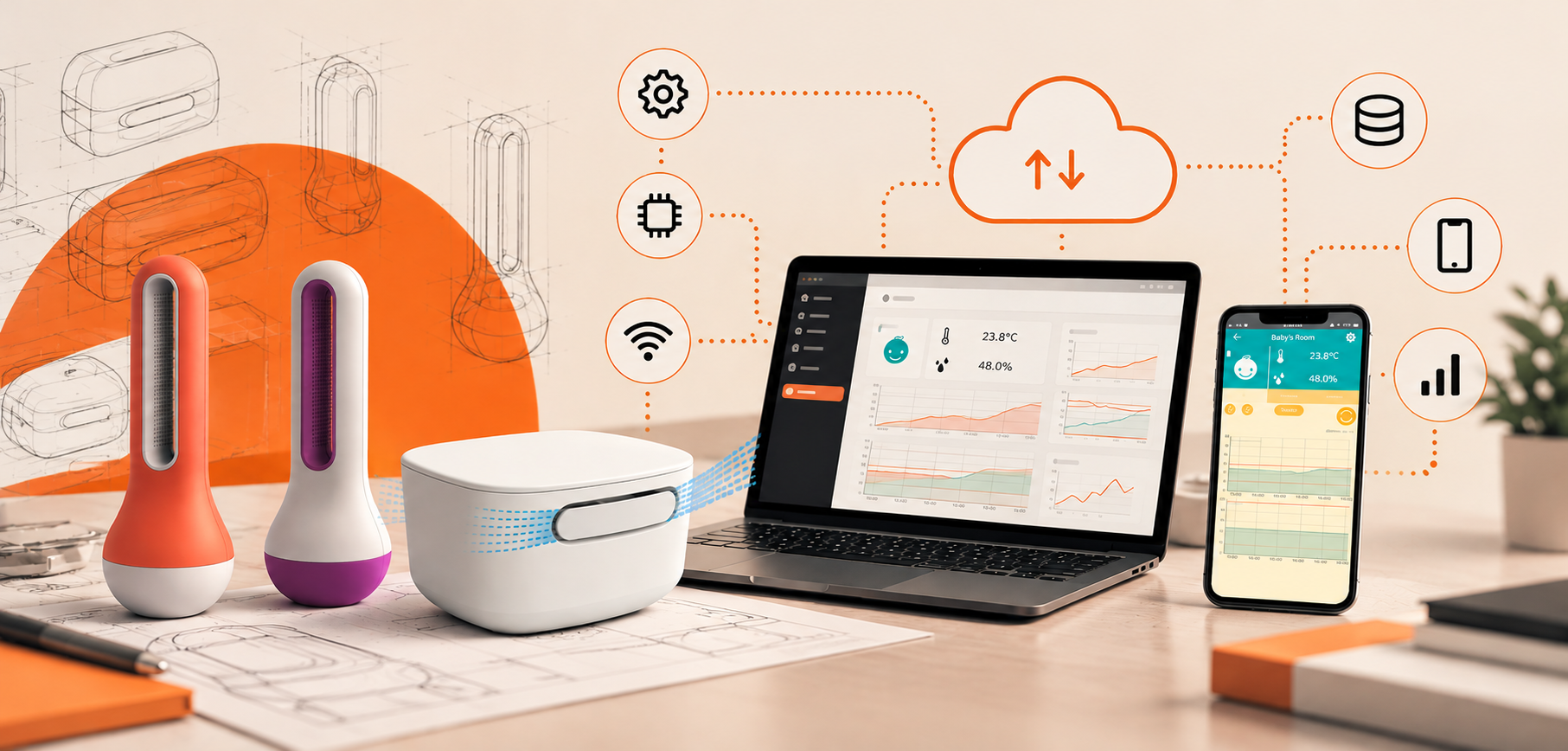
Developing an Internet of Things (IoT) product requires more than hardware or software alone. Connected products often combine electronics, embedded firmware, wireless connectivity, cloud infrastructure, applications, testing, certification, and manufacturing.
For businesses without all these capabilities in-house, IoT development outsourcing provides access to specialised engineering expertise without building an entire multidisciplinary team internally.
But what should you outsource, when does outsourcing make sense, and what should you expect from the process?
This guide covers the benefits and risks of outsourcing IoT development, typical development stages, cost and timeline factors, and how to prepare your project before working with an IoT development partner.
What Is IoT Development Outsourcing?
IoT development outsourcing is the practice of hiring an external engineering company to design, develop, test, or manufacture a connected product or IoT system.
Depending on the project, an IoT development partner may manage the complete product lifecycle or provide specialised support for specific areas such as electronics, firmware, connectivity, cloud infrastructure, applications, testing, or manufacturing.
Unlike traditional software outsourcing, IoT development connects physical and digital systems. Hardware, embedded software, wireless communication, cloud infrastructure, and user applications must work together reliably.
Companies typically outsource IoT development when they lack specialised expertise, need additional engineering capacity, want to accelerate development, or require support moving a prototype into scalable production.
What Parts of IoT Development Can You Outsource?
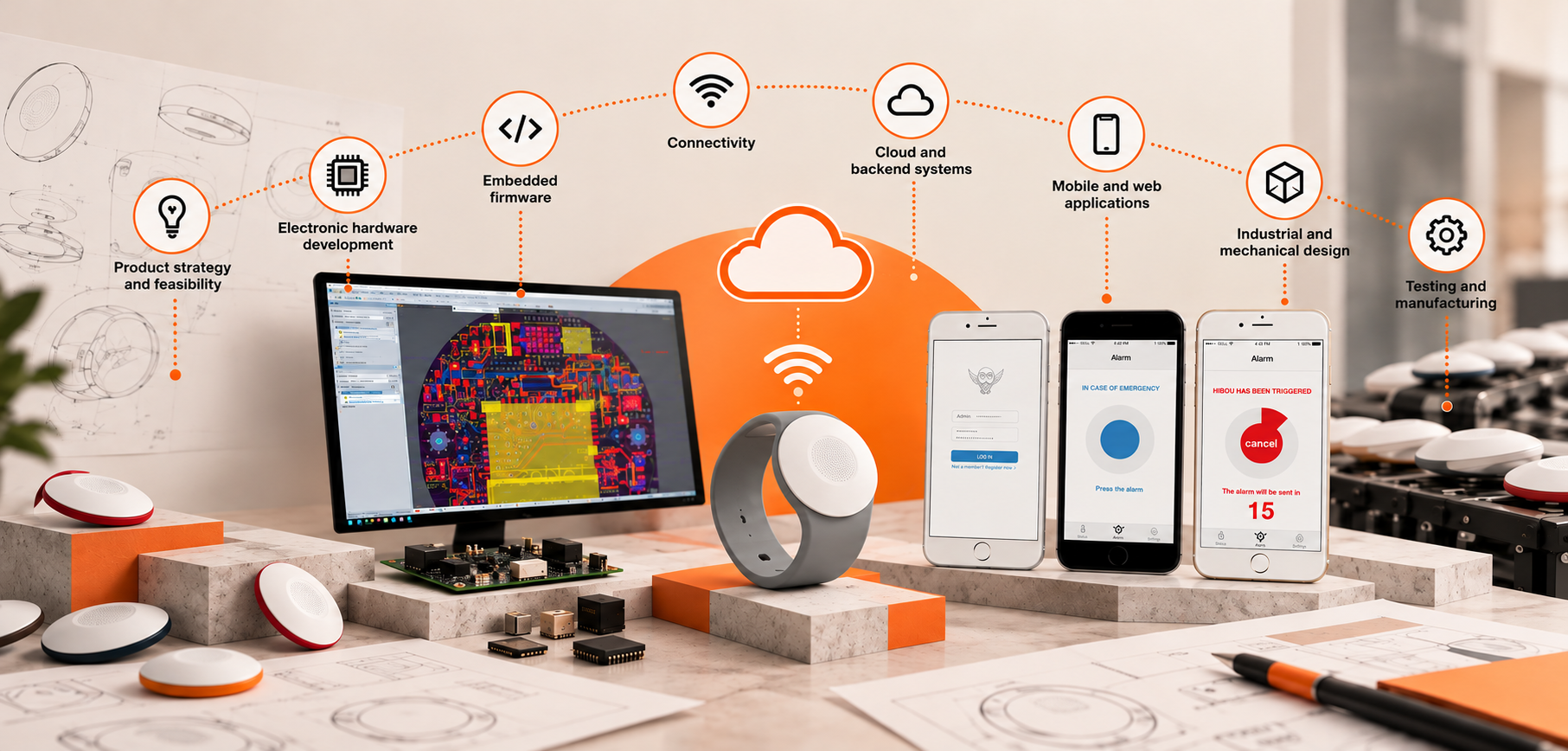
Almost every stage of IoT product development can be outsourced. Businesses may engage a partner for one specialised function or work with an end-to-end development team.
Common areas include:
Product strategy and feasibility: Defining requirements, evaluating technologies, identifying technical risks, and validating whether the concept is practical.
Electronic hardware development: System architecture, component selection, PCB development, sensors, power management, and wireless modules.
Embedded firmware: Device control, sensor processing, connectivity, power optimisation, diagnostics, and over-the-air (OTA) updates.
Connectivity: Integration of technologies such as Wi-Fi, Bluetooth Low Energy (BLE), cellular, Zigbee, LoRaWAN, LTE-M, or NB-IoT.
Cloud and backend systems: APIs, databases, device management, authentication, analytics, and remote monitoring.
Mobile and web applications: Interfaces for configuring, monitoring, and controlling connected products.
Industrial and mechanical design: Enclosures, materials, internal layouts, usability, durability, and product aesthetics.
Testing and manufacturing: Validation, certification support, Design for Manufacturability (DFM), tooling, production testing, and quality planning.
An experienced IoT development partner should also consider how decisions made during early engineering will affect certification, component availability, production cost, and long-term manufacturability.
When Should You Outsource IoT Development?
Outsourcing IoT development makes sense when your project requires expertise, infrastructure, or engineering capacity that would be costly or time-consuming to build internally.
It can be particularly useful when:
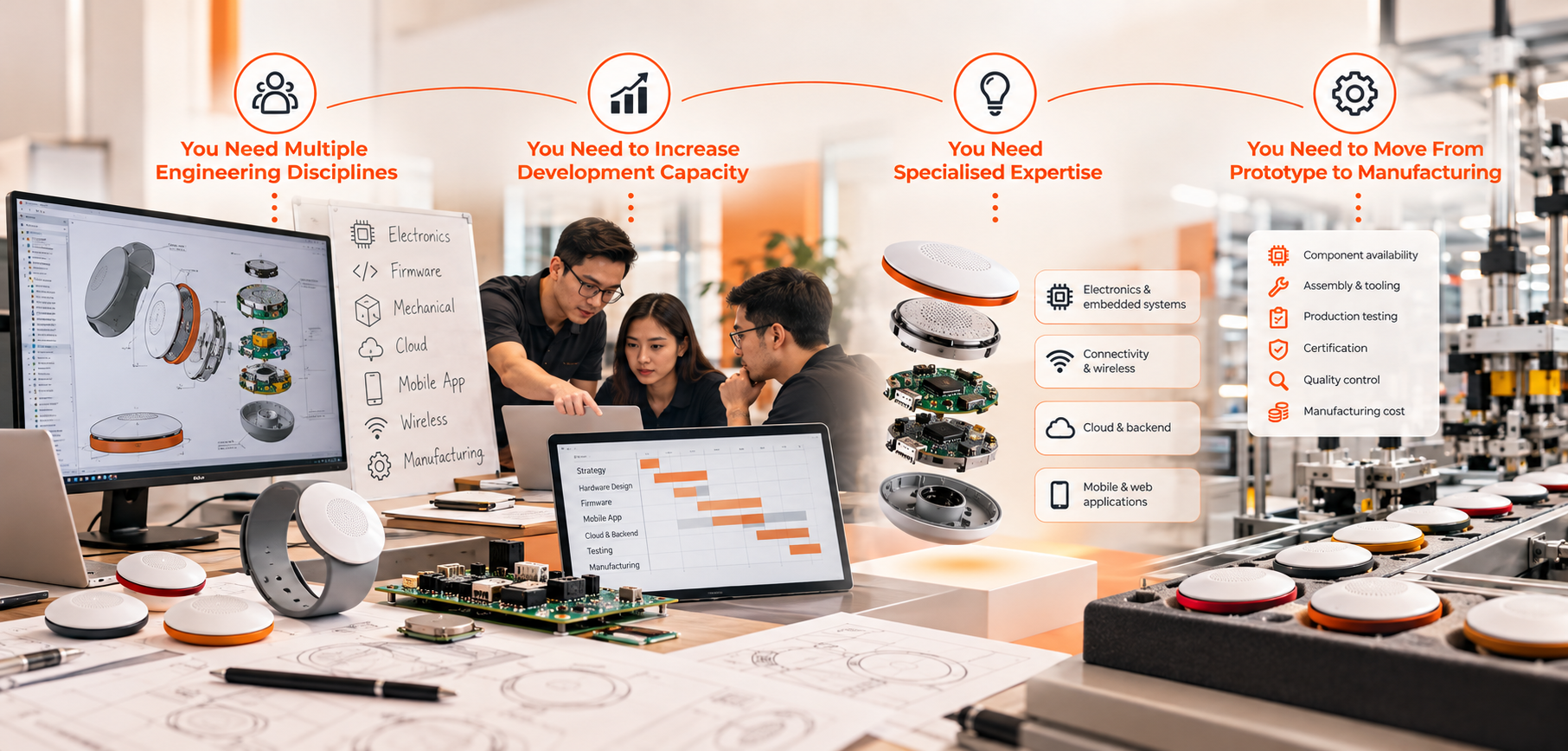
You Need Multiple Engineering Disciplines
Connected products may require electronics, firmware, mechanical, cloud, application, wireless, and manufacturing specialists.
Hiring each discipline internally can require significant time and investment, especially when some expertise is only needed during certain development phases.
You Need to Increase Development Capacity
An established IoT development company already has engineering teams, development infrastructure, and workflows in place.
This allows companies to add resources without recruiting a permanent team for every required discipline.
You Need Specialised Expertise
You may already have strong internal software capabilities but lack electronics or embedded engineering experience. Alternatively, you may have an existing hardware product that needs connectivity, cloud infrastructure, or an application.
Outsourcing can complement your existing team rather than replace it.
You Need to Move From Prototype to Manufacturing
A working prototype is not necessarily ready for commercial production.
Products may need additional engineering for component availability, assembly, tooling, production testing, certification, quality control, and manufacturing cost.
A partner experienced in both engineering and manufacturing can help bridge this gap.
IoT Development Outsourcing vs In-House Development
Neither approach is inherently better. The right choice depends on your existing capabilities, budget, timeline, and long-term product strategy.
| Factor | In-House Development | Outsourced IoT Development |
|---|---|---|
| Engineering team | Requires recruiting and retaining specialists | Access to an established multidisciplinary team |
| Upfront investment | Staffing, equipment, software, and infrastructure | Resources engaged according to project requirements |
| Specialist expertise | Limited to internal capabilities | Access to multiple engineering disciplines |
| Scalability | Limited by available headcount | Resources can change between development phases |
| Control | Direct day-to-day management | Requires structured communication and governance |
| Manufacturing | May require separate resources | Can be integrated with an end-to-end partner |
| Knowledge | Retained directly internally | Requires documentation and knowledge transfer |
Many businesses choose a hybrid model, keeping product strategy and core expertise in-house while outsourcing specialised engineering or manufacturing activities.
What Are the Benefits of Outsourcing IoT Development?
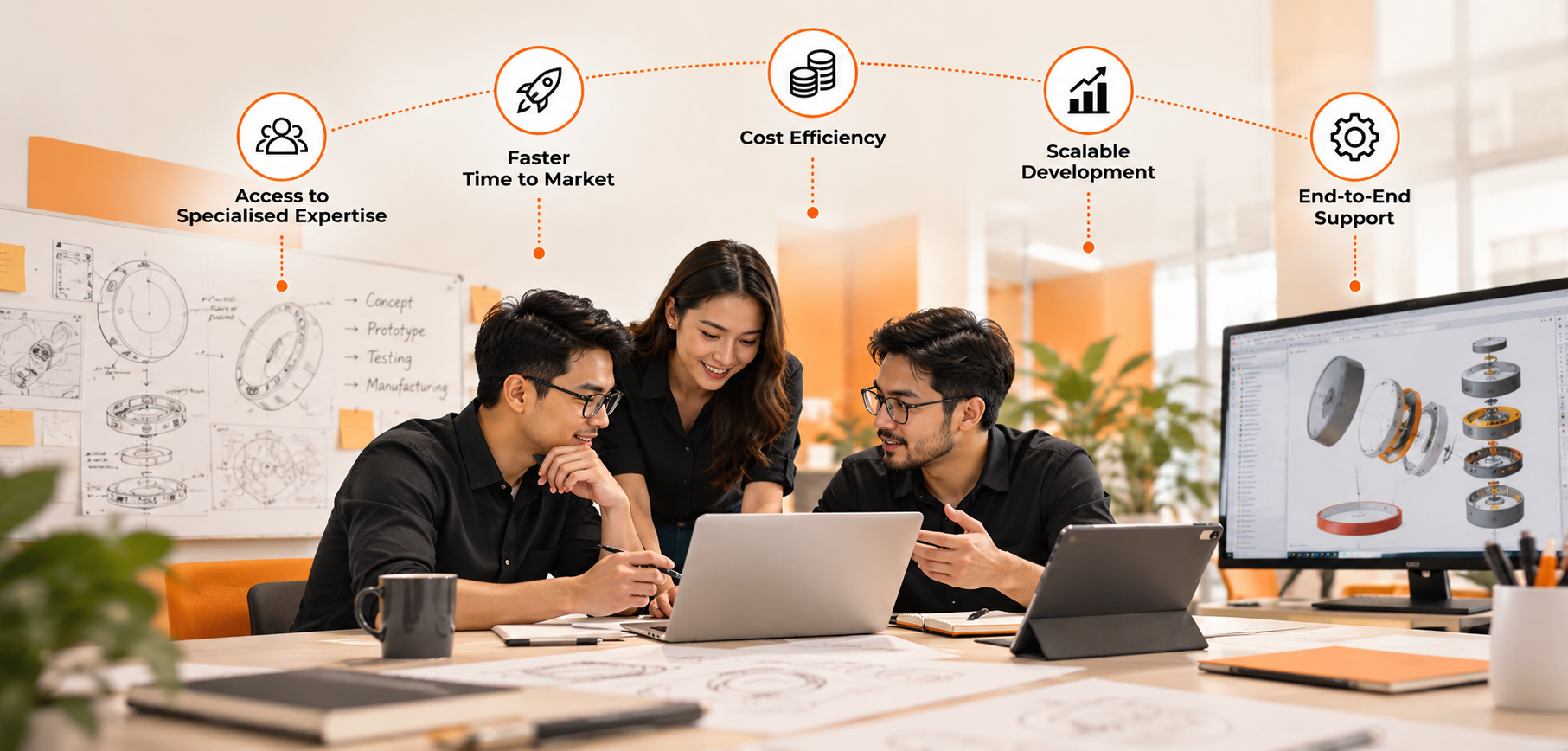
The main benefits of outsourcing IoT development are access to specialised expertise, flexible engineering capacity, faster project mobilisation, and better integration between product development and manufacturing.
Access to Specialised Expertise
IoT products span multiple technical disciplines. Outsourcing can provide access to electronics engineers, firmware developers, industrial designers, cloud developers, wireless specialists, and manufacturing engineers without hiring each role individually.
Flexible Engineering Resources
Resource requirements change throughout development.
A project may need industrial designers and system architects during early concept development, more electronics and firmware resources during detailed engineering, and manufacturing specialists as production approaches.
An outsourced model allows the engineering mix to evolve with the project.
Faster Project Mobilisation
An established team can begin evaluating requirements and technical risks without waiting for every specialist to be recruited internally.
Existing development processes, laboratories, tools, and supplier relationships can also support faster project setup.
Engineering With Manufacturing in Mind
Moving from prototype to production is one of the most challenging stages of hardware development.
Considering component sourcing, DFM, assembly, testing, tooling, and quality requirements earlier can reduce unnecessary redesign when the product approaches manufacturing.
What Are the Risks of Outsourcing IoT Development?
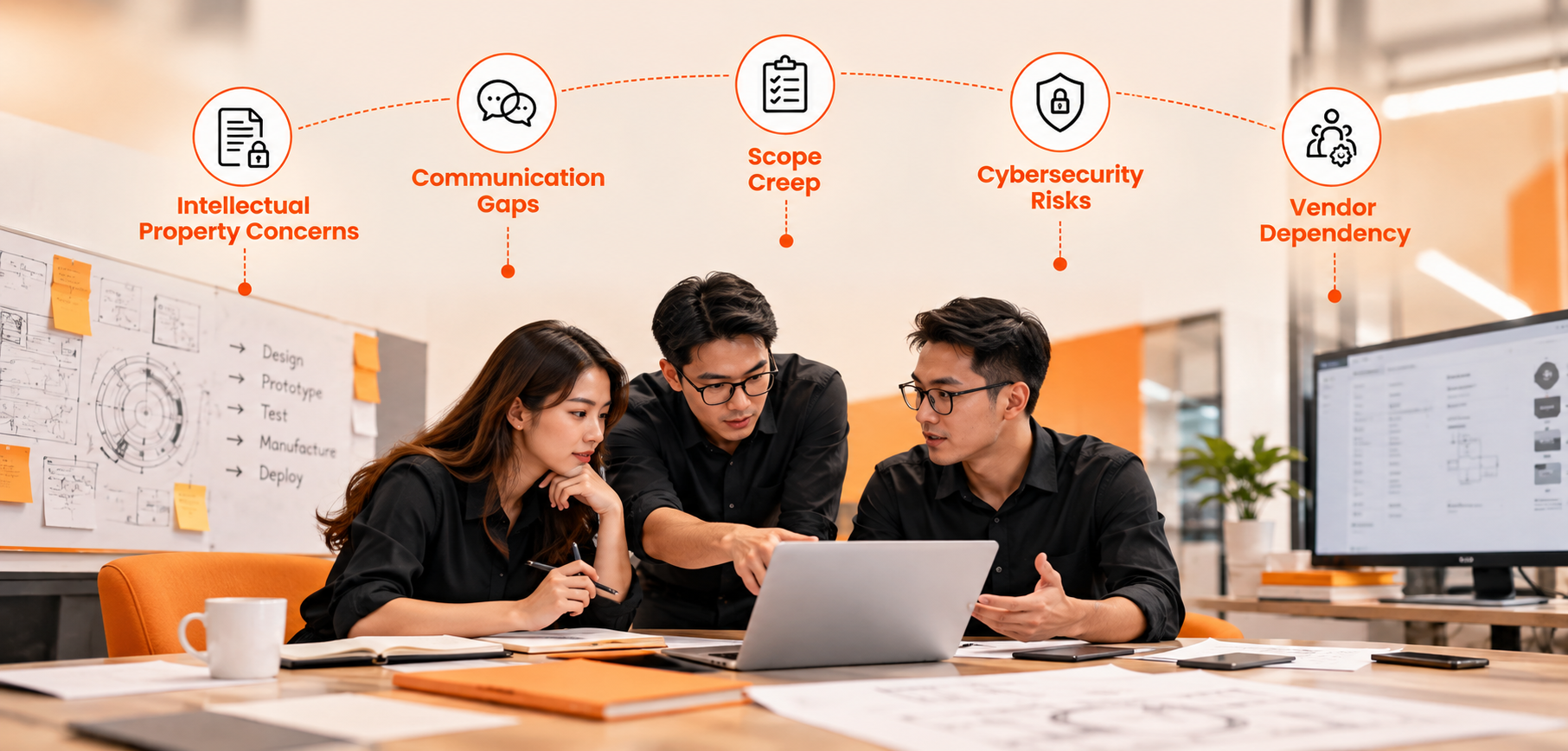
Outsourcing also introduces potential risks, particularly when responsibilities and expectations are unclear.
Common risks include:
Intellectual property concerns: Contracts should define ownership of source code, firmware, electronics designs, CAD files, manufacturing documentation, and tooling.
Communication gaps: Regular technical reviews, milestone demonstrations, and documented decisions help keep multidisciplinary teams aligned.
Scope creep: Requirements can change as prototypes reveal new information. A clear process should exist for assessing changes in cost, scope, and schedule.
Cybersecurity risks: Security requirements should be considered across devices, connectivity, cloud systems, applications, and data from the beginning of development.
Vendor dependency: Ensure appropriate documentation, source files, credentials, manufacturing information, and knowledge transfer are available for long-term product support.
A well-defined development agreement and transparent project management process can reduce many of these risks.
What Does the IoT Development Process Look Like?
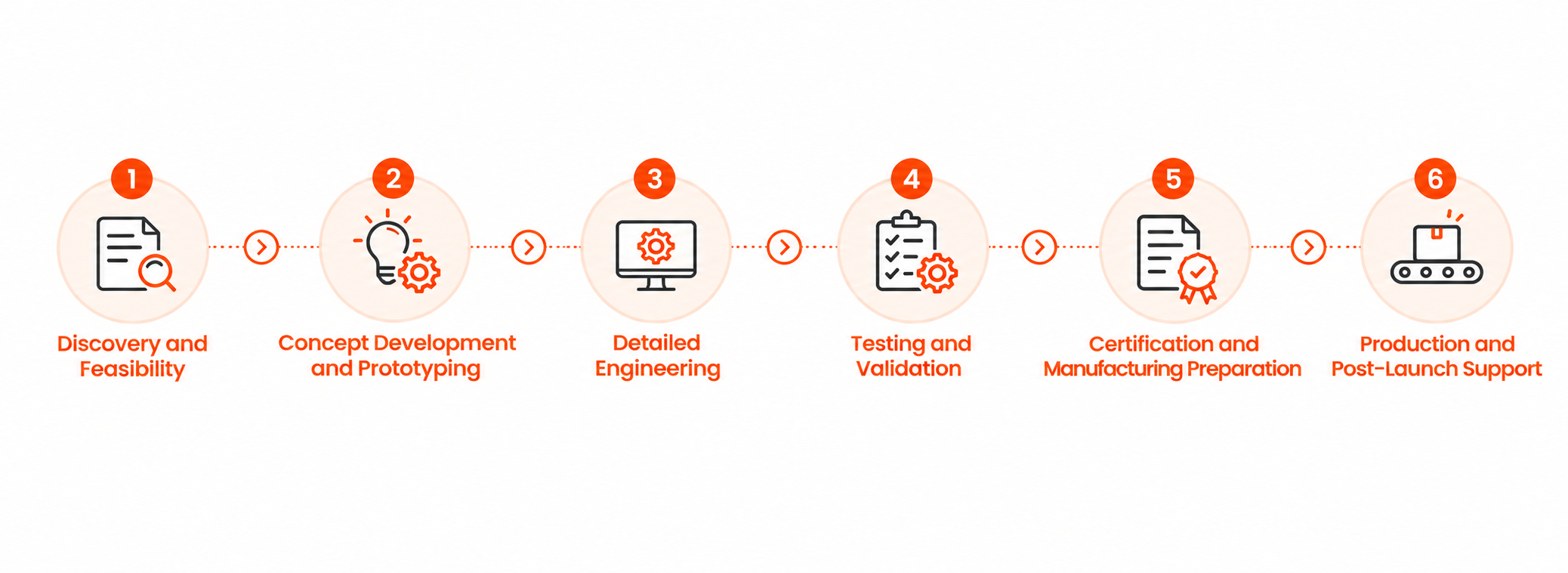
While every product is different, outsourced IoT development usually follows several interconnected stages.
1. Discovery and Feasibility
The team defines the product goals, users, functional requirements, operating environment, technical constraints, and commercial objectives.
Potential architectures and high-risk technical assumptions can then be evaluated before detailed engineering begins.
2. Concept Development and Prototyping
Early prototypes help test critical assumptions around electronics, connectivity, user interaction, mechanical design, or other high-risk areas.
The goal is to learn before committing to a production-ready design.
3. Detailed Engineering
Once the core concept has been validated, the team develops the complete system.
This may include PCB design, embedded firmware, mechanical engineering, cloud infrastructure, APIs, mobile or web applications, and wireless communication.
4. Testing and Validation
Hardware and software are tested against the product requirements.
Testing may cover functionality, battery life, wireless performance, mechanical durability, environmental conditions, usability, security, and regulatory requirements.
5. Certification and Manufacturing Preparation
The design is reviewed for manufacturability while components, suppliers, tooling, assembly processes, production tests, and quality requirements are finalised.
Required regulatory testing and certification are also addressed before commercial launch.
6. Production and Post-Launch Support
Initial production runs validate the manufacturing process before larger volumes are produced.
After launch, connected products may continue to require firmware updates, cybersecurity patches, cloud maintenance, application updates, component substitutions, and future hardware revisions.
How Long Does Outsourced IoT Development Take?
IoT product development can take several months to more than a year depending on complexity, technical risk, certification requirements, and manufacturing needs.
A focused connected product with established technologies may progress faster than a complex platform requiring custom electronics, multiple wireless technologies, cloud infrastructure, applications, certification, and production tooling.
Factors affecting the timeline include:
Hardware and firmware complexity
Connectivity requirements
Mechanical and industrial design
Cloud and application development
Prototype iterations
Testing and certification
Component availability
Tooling and manufacturing preparation
A discovery or feasibility phase can provide a more reliable project timeline after the major technical risks and requirements are understood.
How Much Does It Cost to Outsource IoT Development?
The cost of IoT development outsourcing depends on the product's complexity, engineering scope, technical requirements, and manufacturing needs.
There is no useful universal price because developing a simple connected sensor is fundamentally different from building a complex multi-device IoT platform.
Major cost factors include:
Custom electronics and PCB development
Embedded firmware
Sensors and wireless technologies
Industrial and mechanical design
Cloud infrastructure
Mobile or web applications
Cybersecurity requirements
Prototype iterations
Testing and certification
Tooling and manufacturing preparation
Projects with uncertain or evolving requirements are often handled using time-and-materials arrangements, while clearly defined development phases may use fixed-price agreements. Some projects combine both approaches.
Starting with a feasibility or discovery phase can help define the technical architecture, risks, timeline, and expected development budget before committing to full development.
How to Prepare Before Outsourcing an IoT Project
You do not need a complete technical specification before approaching an IoT development company. However, providing clear objectives and known constraints can make early discussions more productive.
Define the Problem
Explain what the product needs to accomplish, who will use it, where it will operate, and what problem it solves.
Starting with the problem gives engineers flexibility to evaluate the most appropriate technical solution.
Document Known Requirements
List requirements such as expected battery life, product dimensions, operating environment, sensors, connectivity, user interfaces, target manufacturing cost, production volume, and regulatory considerations.
Separate essential requirements from desirable features.
Gather Existing Materials
Share relevant product sketches, prototypes, CAD files, source code, schematics, market research, user research, or previous test results.
Existing work helps the development team understand what has already been explored.
Define Commercial Constraints
Communicate your target launch window, development budget, expected production volumes, and manufacturing cost targets.
These factors can influence technology choices and product architecture.
Clarify Security and IP Requirements
Determine what security, privacy, certification, and regulatory requirements may apply.
You should also establish ownership of source code, firmware, electronics designs, mechanical files, tooling, manufacturing documentation, and other project assets before development begins.
What Should You Ask an IoT Development Partner?
Once you decide to outsource, evaluate whether a potential partner can support both the technical and commercial requirements of your product.
Useful questions include:
Have you developed products with similar technical requirements?
Which engineering disciplines are handled internally?
How do hardware, firmware, cloud, app, and manufacturing teams collaborate?
How do you identify and manage technical risks?
What testing and certification support do you provide?
How do you prepare products for manufacturing?
Who owns the source code, design files, and intellectual property?
What support is available after launch?
For a deeper evaluation framework, read our guide on How to Choose an IoT Development Partner.
Frequently Asked Questions About IoT Development Outsourcing
Is it better to outsource IoT development or build an in-house team?
It depends on your existing capabilities and long-term strategy. In-house development provides direct control and retains expertise internally. Outsourcing provides access to specialised engineering resources without recruiting every discipline. Many companies use a hybrid model that combines internal product expertise with external engineering support.
What parts of IoT development can be outsourced?
Companies can outsource electronic engineering, PCB development, firmware, wireless connectivity, mechanical and industrial design, cloud infrastructure, applications, testing, certification, manufacturing preparation, and production support. A partner can handle individual disciplines or the complete development lifecycle.
How long does IoT product development take?
IoT development can take several months to more than a year. The timeline depends on hardware and firmware complexity, connectivity, applications, prototype iterations, testing, certification, tooling, and manufacturing requirements.
Who owns the IP when IoT development is outsourced?
IP ownership depends on the development agreement. Contracts should clearly define ownership and access rights for source code, firmware, electronics designs, CAD files, manufacturing files, documentation, tooling, and other project assets before development begins.
Can an IoT development partner handle manufacturing?
Yes, some IoT development partners provide engineering and manufacturing support. Services may include Design for Manufacturability, component sourcing, tooling, production testing, quality control, production ramp-up, and ongoing manufacturing support.
From IoT Concept to Production
Outsourcing IoT development can give companies access to specialised expertise across electronics, firmware, connectivity, cloud systems, applications, testing, and manufacturing without building every capability internally.
The key is choosing an approach that fits your existing team, technical requirements, budget, timeline, and long-term product strategy.
Tektos Ecosystems supports connected product development from early feasibility and engineering through manufacturing and post-launch support. With more than 20 years of product development experience, Tektos has completed more than 200 collaborations, manufactured over one million products, and supported more than 70,000 connected IoT devices.
Whether you're validating an early idea, developing a prototype, building a complete IoT ecosystem, or preparing an existing design for manufacturing, an integrated engineering approach can help connect the decisions made during development with the realities of commercial production.