
Ripple & Noise Signal Check: Charger Output Stability
(Ripple, Noise, Voltage & Frequency Accuracy)
Even minor fluctuations in voltage, commonly referred to as ripple, or transient electrical noise, can disrupt device performance. These disturbances may trigger unexpected resets, sensor malfunctions, or wireless communication issues, making ripple and noise signal testing an essential step in product quality engineering.
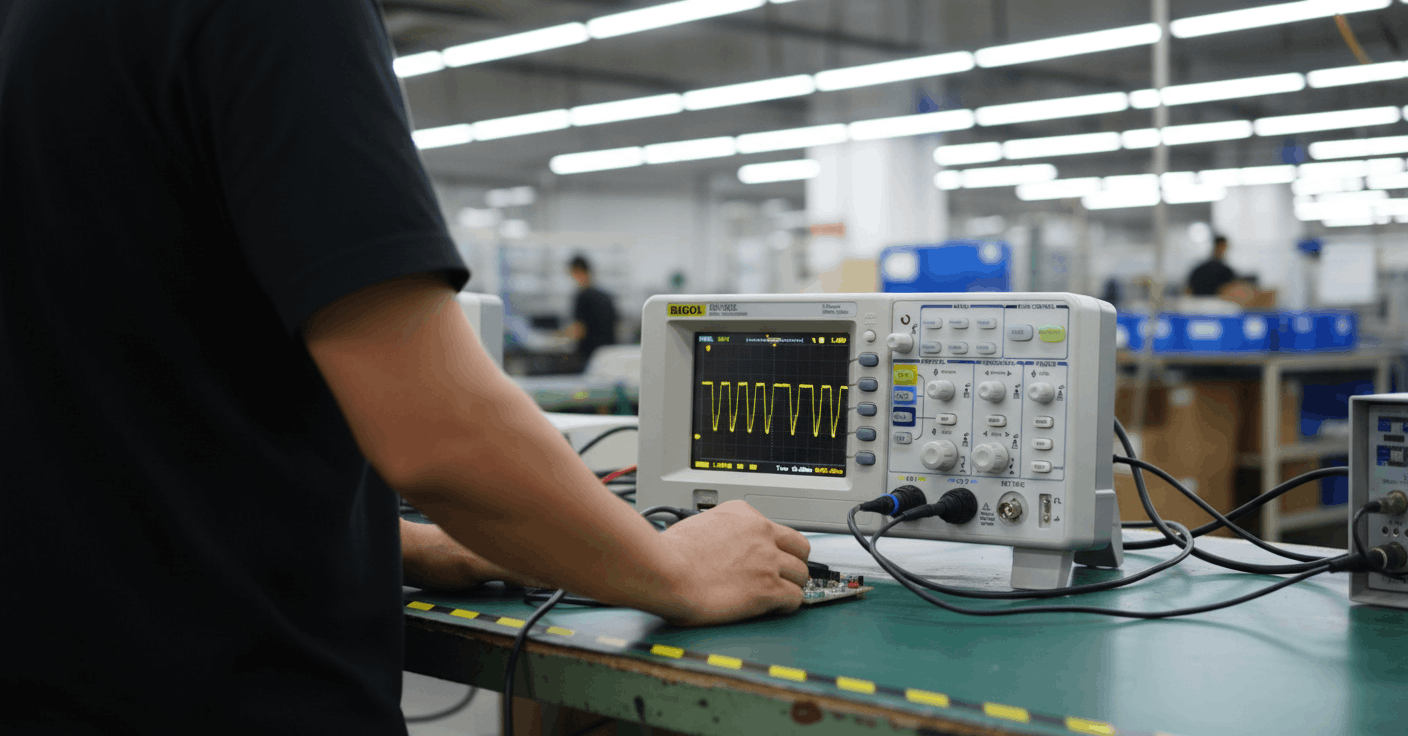
At our facilities, we employ precision oscilloscopes and advanced measurement techniques to evaluate the quality of electrical signals in power outputs. This testing includes assessing ripple, voltage, frequency accuracy, and noise levels across various operating conditions. By doing so, we can identify potential instability in early stages, allowing engineers to address issues before they affect product performance or safety.
What We Do
Our testing process is thorough and adaptive. Voltage noise is measured under a range of load conditions, switching scenarios, and different input sources. This comprehensive approach ensures that the power supply behaves consistently, regardless of how the device is used in real-world situations.
Using high-resolution oscilloscopes, we capture transient spikes, harmonic disturbances, switching ripple, and power-rail behavior across multiple frequency bands. These visualizations provide engineers with a clear picture of the electrical environment within the device, highlighting areas where noise or ripple could compromise operation.
When anomalies are detected, targeted corrective measures are applied. This may include optimizing capacitor networks, improving filtering strategies, enhancing grounding techniques, and refining PCB routing. By addressing noise at its origin, we ensure that power delivered to all subsystems is as clean and stable as possible.

Why It Matters
Unstable power is one of the most common yet difficult-to-diagnose causes of erratic device behavior. Even a minor ripple or noise can propagate through circuits, affecting multiple components simultaneously. Correcting these issues at the design and manufacturing stage is far more efficient than troubleshooting failures after deployment.
Beyond preventing malfunctions, proper ripple and noise management contribute to overall product longevity. Devices operating on stable power tend to be more energy-efficient, generate less heat, and maintain performance consistency throughout their lifecycle. This is especially critical in sectors like IoT, telecommunications, automotive electronics, and medical devices, where reliability is non-negotiable.
Investing in comprehensive ripple and noise checks is not just a technical necessity—it is a commitment to quality, reliability, and customer satisfaction. Through careful measurement, analysis, and refinement, we help devices perform at their best, setting a higher standard for stability and longevity in electronic products.