
You have a working product. The design is polished, the electronics perform as expected, and the connected prototype communicates reliably.
But a successful prototype is not yet a market-ready product.
Before launch, two critical questions still need to be answered:
Can you manufacture the product consistently at scale?
And:
Does it meet the requirements of the markets where you intend to sell it?
This is where product quality control and the product certification process become essential.
When quality and compliance are considered early, they become part of a controlled path from prototype to production. When they are left until the end, defects, component changes, failed tests, or missing documentation can delay a launch when they are most expensive to correct.
For product teams preparing for manufacturing, the goal is therefore not simply to “pass inspection.” It is to build quality and compliance into the transition from prototype to market-ready production.
Why Quality and Certification Should Start Before Mass Production
Quality control and certification are sometimes treated as final checks before shipment.
In practice, decisions made much earlier, from component selection and product design to manufacturing setup, can determine whether a product remains reliable at scale and whether it can meet applicable market requirements.
Three principles are particularly important.
1. Maintain Product Quality as Production Scales
A prototype may perform perfectly while the ten-thousandth manufactured unit does not.
One risk is quality fade: the gradual erosion of manufacturing quality from one production batch to another.
A component may be substituted. A tolerance may drift. A production setting may change. A quality check may be reduced over time.
These changes can be difficult to notice during individual production runs but eventually appear as inconsistent performance, higher return rates, or product failures.
Strong manufacturing quality control helps detect those deviations before affected units reach customers.
For example, if an approved component is replaced with an unqualified alternative, incoming or in-process controls can identify the change before an entire batch is completed and shipped.
2. Understand Market Requirements Early
A product also needs to meet the requirements that apply to its technology, intended use, and target markets.
Depending on the product and destination, considerations may include CE requirements in Europe, FCC requirements in the United States, RoHS and REACH requirements, and technology-specific programs such as Qi certification for compatible wireless-charging products.
The important point is not to memorize every possible certification.
It is to identify the applicable requirements early enough that they can influence product design, component selection, testing, documentation, and manufacturing planning.
This turns hardware certification into a planned development milestone rather than a problem discovered immediately before launch.
For a deeper look at how Tektos approaches international product certification and market access, see our Compliance & Sustainability expertise.
3. Detect Problems Where They Are Cheapest to Fix
The economics of quality are often illustrated using the 1-10-100 rule.
A problem that costs 1 to correct at its source may cost 10 once it reaches production and 100 once it reaches the customer through rework, returns, recalls, or reputational damage.
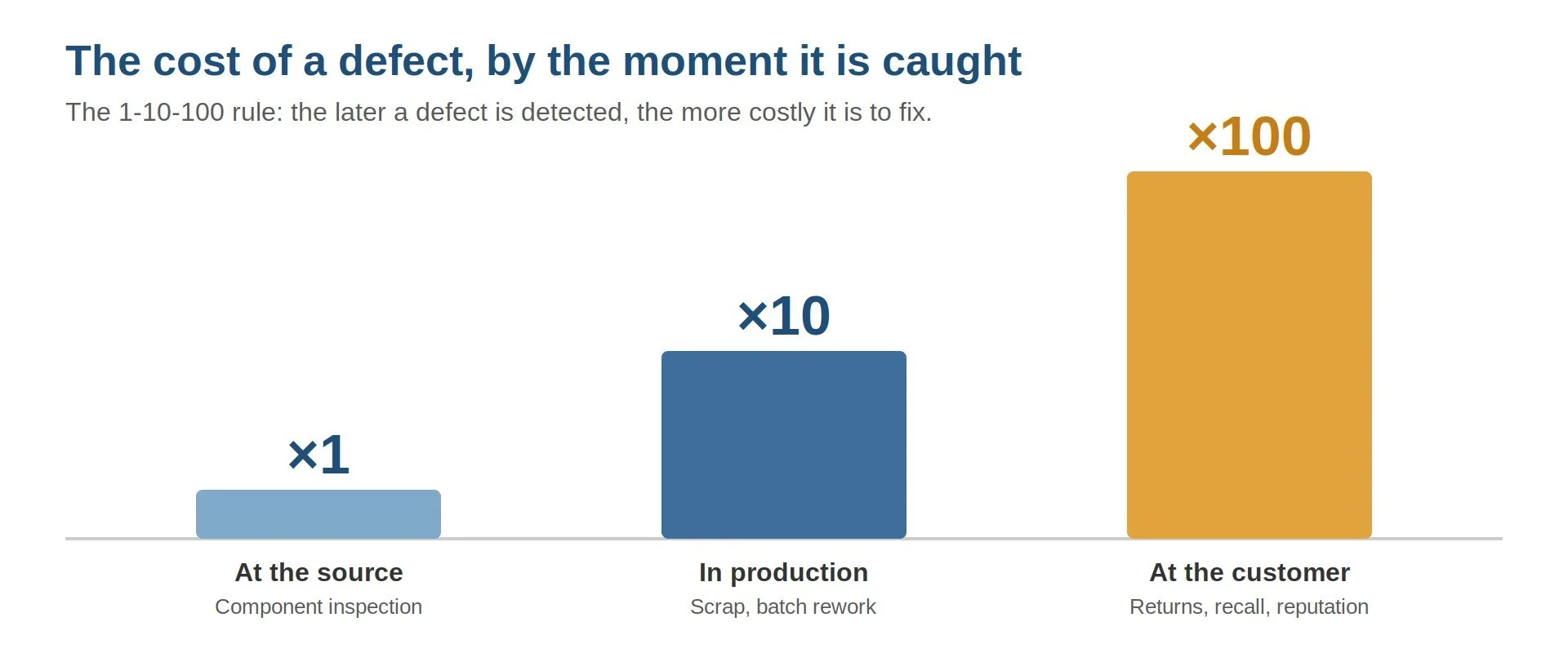
The lesson is simple: the later a problem is detected, the more expensive it becomes.
Effective product quality assurance is therefore not about adding as many inspections as possible. It is about placing the right controls at the stages where they can prevent defects from moving further through production.
Building Product Quality Control Into Manufacturing
Quality should not depend on a single final inspection.
A more reliable approach creates checkpoints throughout manufacturing, from incoming components to production, functional testing, outgoing inspection, and traceability.
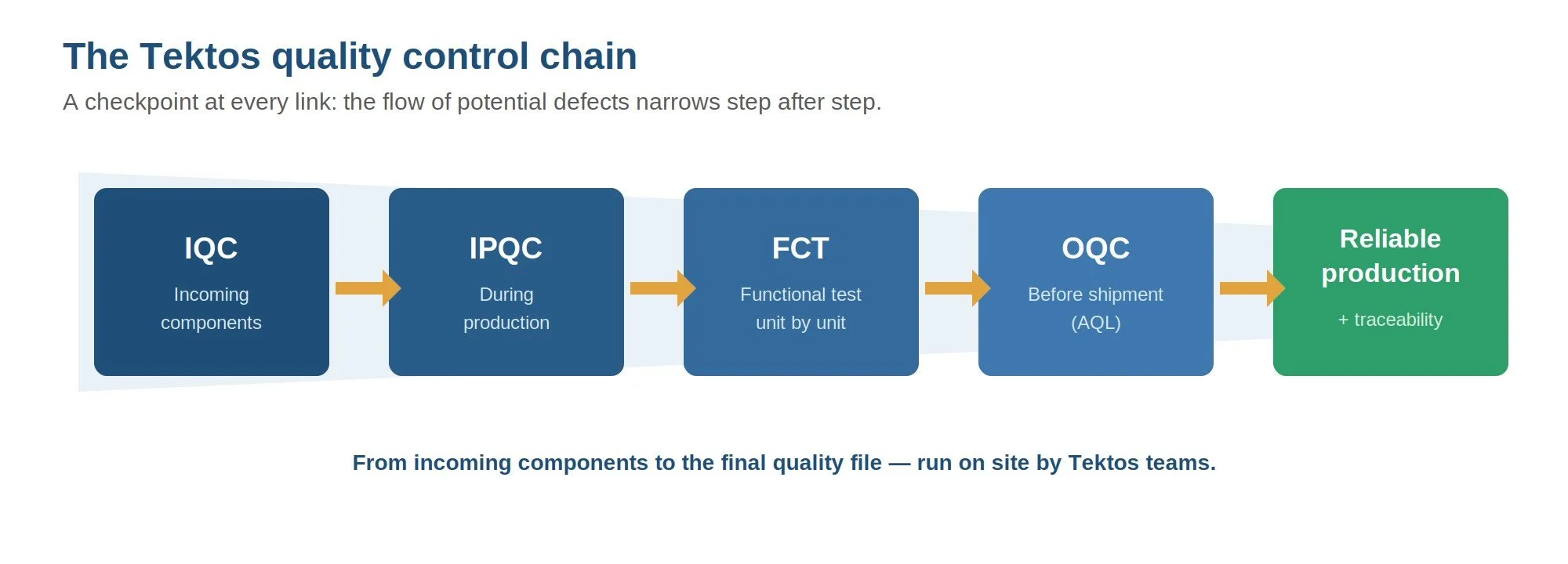
| Stage | What Is Checked | Why It Matters |
|---|---|---|
| IQC — Incoming Quality Control | Incoming components, references, authenticity, and applicable compliance documentation | Helps prevent unsuitable or incorrect components from entering production |
| IPQC — In-Process Quality Control | First articles, machine settings, process conditions, and production-line drift | Helps maintain consistency while products are being manufactured |
| FCT — Functional Testing | Product functionality against defined specifications | Confirms that manufactured units perform as intended |
| OQC — Outgoing Quality Control | Finished batches using defined inspection and sampling procedures | Provides a final quality checkpoint before shipment |
| Traceability / Quality File | Batch information, component records, test results, and production documentation | Makes it easier to investigate issues and support audits or corrective actions |
Each stage addresses a different type of production risk.
Together, they create a traceable quality chain that helps teams identify not only whether a problem occurred, but also where and when it entered the manufacturing process.
For connected and electronic products, this becomes increasingly important as production scales and more suppliers, components, and manufacturing processes become involved.
Tektos supports these activities as part of its Product Manufacturing & Quality Assurance services, helping product teams move from production setup to repeatable, controlled manufacturing.
Where Product Certification Fits Into the Process
Manufacturing a reliable product is only one part of market readiness. The product must also satisfy the requirements that apply to where and how it will be sold.
The exact product certification process varies by product, technology, and destination, but certification planning generally needs to answer three questions:
Which requirements apply to the target markets?
Do the selected components and technologies support those requirements?
What testing and documentation will be needed before launch?
These questions should be addressed before the product reaches final production.
Market Requirements
Different destinations may apply different regulatory or technical requirements.
For electronic and connected products, this can involve requirements relating to electromagnetic compatibility, radio-frequency technologies, materials and substances, electrical safety, or specific product features.
Rather than treating certification as a single final test, teams should map applicable requirements against the product's intended markets early in development.
Component-Level Compliance
Compliance also depends on the components inside the finished product. Component references, supplier documentation, material declarations, and traceability may all affect the final compliance path.
Checking these factors upstream reduces the risk of discovering late in the project that a selected component creates a regulatory or documentation problem.
Documentation and Traceability
Testing alone is not enough. Technical documentation, test reports, component records, declarations, and production information may also form part of demonstrating product compliance and readiness.
Keeping those records structured throughout development and manufacturing makes the later certification process easier to manage. Certification requirements vary significantly by product and market.
Product Validation Before Launch
Before a product is released at scale, manufacturing teams need evidence that production is delivering what the product was designed to do. This is where product validation and testing connect engineering requirements with real production output.
Depending on the product and manufacturing process, validation may include:
functional testing against defined product specifications;
automated inspection during electronics assembly;
sampling and outgoing quality inspections;
component and batch traceability; and
structured test and quality documentation.
The objective is not simply to create more tests.
Each validation step should address a specific risk and produce useful evidence about whether the manufactured product meets the intended requirements.
For example, functional testing can verify whether a unit genuinely performs as specified, while automated inspection during electronics assembly can identify manufacturing defects before they progress further through production.
Before shipment, defined sampling procedures such as AQL-based inspection may also be used as part of the decision process for finished batches.
For a deeper look at Tektos' production testing, validation, and quality engineering capabilities, see our Manufacturing Quality Expertise.
From Prototype to Market-Ready Production
The transition from prototype to market is not one single step. A product must move through several connected decisions:
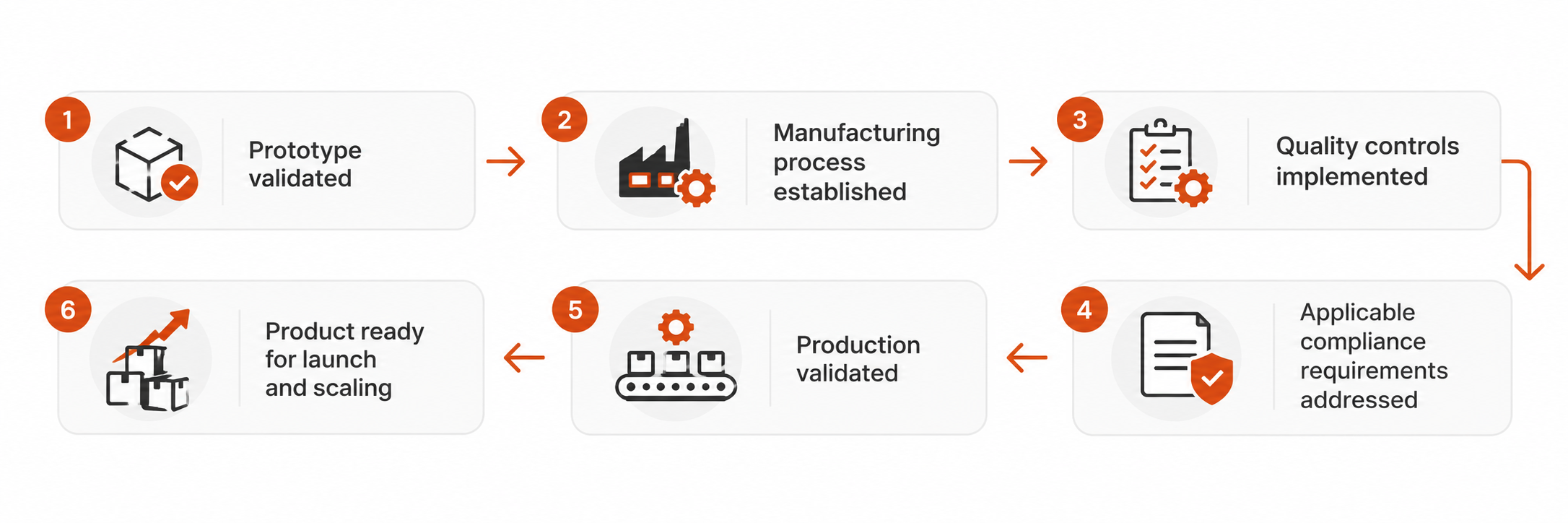
Problems often arise when these activities are treated separately.
A component decision can affect certification. A manufacturing change can affect product performance. A quality issue can create documentation and traceability problems. A late regulatory requirement can force changes to a product that was otherwise considered production-ready.
The more these considerations are connected throughout development and manufacturing, the more predictable the path to launch becomes.
Preparing Your Product for Production
A technically successful prototype is an important milestone—but market readiness requires more.
The product needs to be manufactured consistently, validated against its requirements, supported by traceable quality controls, and prepared for the compliance requirements of its intended markets.
That is why product quality control and certification should be planned as part of the product-development and manufacturing process, rather than treated as final obstacles before launch.
Tektos works with product teams across engineering, manufacturing, testing, and quality assurance to help turn validated prototypes into reliable, production-ready products.
Moving From Prototype to Production?
If you're preparing a new product for manufacturing or looking to improve the reliability of an existing production process, explore our Product Manufacturing & Quality Assurance services.
Tektos can help assess production readiness, manufacturing controls, testing requirements, and the next steps needed to move toward reliable production at scale.
Frequently Asked Questions About Product Quality Control and Certification
What is product quality control?
Product quality control is the process of checking components, manufacturing processes, finished units, and production batches against defined requirements.
Rather than relying only on final inspection, quality controls can be introduced at different stages of manufacturing to identify deviations before they affect larger quantities of finished products.
What is product certification?
Product certification and compliance activities are used to demonstrate that a product meets applicable requirements for its product category, technology, intended use, and target market.
Depending on the requirement, this may involve testing, technical documentation, declarations, registrations, or third-party assessment.
When should product certification be considered?
Certification requirements should be considered before final production.
Identifying applicable requirements earlier allows product teams to account for them during component selection, design, testing, documentation, and manufacturing planning instead of discovering them immediately before launch.
What certifications or compliance requirements apply to electronic products?
Requirements depend on the product and where it will be sold.
Electronic and connected products may need to consider requirements relating to areas such as electromagnetic compatibility, radio-frequency technologies, electrical safety, restricted substances, environmental compliance, or technology-specific certification programs.
The applicable requirements should therefore be assessed for the specific product and target markets.
How does quality control affect product manufacturing?
Quality control helps identify manufacturing deviations before they affect larger production volumes or reach customers.
A structured quality-control process can support product consistency, reduce rework and returns, improve traceability, and provide useful information when production issues need to be investigated.
What is AQL sampling?
AQL sampling uses a statistical sampling plan to inspect a defined portion of a production lot against established acceptance criteria.
It can be used as part of outgoing quality control to support decisions about whether a finished production lot meets the agreed inspection requirements before shipment.